Author Archives: Deacon Chris

Unknown's avatar

About Deacon Chris

I am a Catholic deacon of the Archdiocese of Omaha. I work as the Development Director of my parish, St. Gerald Church in Ralston, NE.

Patience is a virtue, but . . .

It’s something that I don’t have much of.  And it’s not a secret, either — my family, my friends, my co-workers and certainly my wife would agree that I need to work on patience (often and comprehensively). 

For now, I am just content to struggle with seeking patience.  Consequently, I take a particular interest in anything that doesn’t require patience.  I’d rather watch something vaguely interesting on Encore or IFC over something that I actually like showing on a network channel.  Not only are there too many commercials per break; but they also occur way too frequently throughout the program.

Take The Office, for example — I’ve taken to watching it, but only by taping it on the DVR to watch later when I can fast forward through the commercials.  I think the show ends up being about 20 minutes with 10 minutes of annoyance.  That’s ridiculous.

My impatience drives another quirky habit — before I wil read a magazine I have to go through it completely and remove all the annoying inserts.  I don’t like my reading to be interrupted by those kind of “magazine commercials” either.  Too many of them, thicker, rougher paper and overly redundant.  I mean, how many subscription cards does one issue really need? 

So I was quite delighted when Erika showed me a copy of Cook’s Illustrated.  She received a complementary copy for some reason.  I read it cover to cover the other day and enjoyed it thoroughly.  Here’s the top three things I like about this publication:

  • First off – they don’t accept advertising, so there isn’t any in the magazine
  • They test recipes and brands and cookware in the vein of Consumer Reports and share their findings with their readers
  • There are a lot of illustrations and how-to diagrams for various cooking techniques

So, I will be buying a subscription to Cook’s Illustrated.  And a word to the rest of the publishing world — I’d read more of what you spew forth if you’d lay off those stupid insert cards and advertising on every other page.

I’ll keep working on the virtue of patience, who knows maybe someday I’ll be content to read a regular magazine or watch a network show . . . maybe
Categories: Cooking, Ranting | 2 Comments

Persistance in Prayer – Orans Position

Here is an excerpt from the homily I delivered this weekend – many people commented on the information regarding the orans position. 

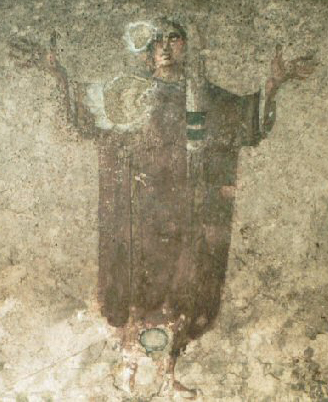
  orans.jpg

Have you ever wondered what’s so special about lifting up his arms, anyway?  I think it’s simply a method of Moses praying for his people.  One of the things Moses did a lot of, was to intercede before Yahweh for the people.

Raising your arms is an ancient posture of prayer.  If you visit the catacombs outside of Rome you can still see today images of the first Christians standing with their arms outstretched in prayer.  We call it the “orans” position. Because it symbolizes lifting our prayers up to heaven, up to our God.

In Psalm 140 David described this kind of prayer beautifully, “Let my prayer come before you like incense, the raising of my hands like the evening offering.”  So this ancient orans position is at the very least 3,000 years old, maybe even 4,000 years old.

And that’s why Fr. Gary uses the orans position so often during Mass.  He’s offering the collective prayers of each of us to the Father.

I mentioned earlier that prayer was the most valuable thing we have as Christians.  As Catholics we can go one step further, and say that the Eucharist is the most valuable prayer that we have, period.

You see, we take absolutely serious Jesus command on Holy Thursday, do this in memory of me.  Or to use the more precise words from First Corinthians, “This chalice is the new covenant in my blood.  Do this as often as you drink it, in remembrance of me.”

Now Jews drink wine every day – and so we celebrate Mass every day.  And Jews drink wine in a more festive, ritualized way on the Sabbath – and so we celebrate Sunday Mass with greater festivity and solemnity, with music and an extra reading, and so forth.

What makes the Eucharist so valuable is its completeness – the Eucharist is a sacred way to transcend time and to actually be with Jesus at the Last Supper, to be with Him during His Passion and death, and to rejoice in His resurrection from the dead.  All three of those components packed into one continuous prayer.

The Eucharist is special in another way, too.  It is a prayer that is offered by the Son to the Father, through the Holy Spirit.  A prayer that shows the love and connectedness of the Holy Trinity each and every time we participate in it.

Much of what is pre-figured in the Old Testament is perfected in the New.  The Last Supper that Jesus celebrated with his Apostles on Holy Thursday was a perfection, a completion of the Passover.  The sacrifice of a lamb for each family was perfected by the offering of the Lamb of God to the Father.  The instruction to place blood on the door frames and lintels was perfected by the blood that fell from the arm and the tree of the cross.

And the ancient manner of prayer – the way in which Moses lifted up his hands to assist his army; the way in which David lifted his hands before the Ark of the Covenant; the way in which the earliest Christians offered their prayers in the catacombs – this very posture was perfected by Jesus as well when He turned his wrists and had them nailed to the cross.

Jesus lived out Psalm 140 in the most beautiful and complete way:  Not only was his prayer like incense, his whole life was lifted up to the Father; not only were His hands raised like the evening offering, they became the eternal offering – the offering that redeemed the entire world.

So the next time you raise your arms in prayer, thank our Lord Jesus for the unique way that He stretched out his hands for love of you.

Categories: Homiletics, Prayer | Leave a comment

The blood of the martyrs . . .

In his work Apologeticum written in 197 Tertullian included this famous line, “the blood of the matyrs is the seed of the Church.” (Chapter 50)

 Nothing could be more true, and the truth of his famous line is shown in both today’s feast of St. Ignatius of Antioch, as well as Friday on the feast of the [Jesuit] North American Martyrs.

 Last night during RCIA I shared with the class the vast size of the Catholic Church, and how it all began with the immediate followers of Jesus, the Apostles.  Many of the early Christians were martyrs, and at given times of Roman persecution, MOST of the Christians were martyred.

The incredibly high number of those willing to give their lives for their belief in Jesus Christ is awe-inspiring.  It’s also historical proof of the validity of the Gospel.  One or two fanatics might follow a false messiah, but thousands and thousands of them attest to the truth.  The truth of the Son of God, and what He did for all the world.

The witness we honor today (martyr is the Greek word for witness) was killed in 107.  He was sent a message to come back to Rome and face accusations.  He knew he would be killed, but he went anyway.  He took his deacons with him, and wrote letters to various churches on the journey.  He faced his death with bravery and an unwavering dedication to his Savior.

The North American Martyrs were eight Jesuit missionaries slaughtered for their belief in Christ by Huron and Iroquois Indians in the middle of the 17th century.  The very same fortitude that brought Ignatius to the Coliseum animated these Jesuit missionaries as they preached the Gospel in the New World.  Even though separated by over 1,500 years, the intensity of belief, and the willingness to give up everything for their Lord, links these witnesses together forever.

Pray for us, holy witnesses to the Truth – your example inspires awe in us on this very day!

Categories: Catechetics, Jesuits, Saints | Leave a comment

Movin’ On Up . . .

For multiple reasons I am moving my blog.

I will attempt to move the existing content as well, but we’ll see how easy the migration goes.

In any event, I will recommence regular blogging at the new address:

deaconchris.com

Thanks to all my loyal readers, and even those just looking around!

God bless you all,

Rev. Mr. Chris

Categories: Commentary | Leave a comment

Lobster Pound

One of the neat things we did while in Maine was to visit a lobster pound, and have dinner there.

(shown at right my wife and I enjoy our lobsters at Thurston’s)

A lobster pound is an imPOUNDment of seawater near a harbor when lobsters are held until they are sold on the wholesale or retail markets. They came about as an after-thought – some of the pounds started to cook a lobster for customers on the side, and the idea took off. For those of us in the Midwest, it’s not terribly unlike the former stockyards for cattle or swine.

Mount Desert Island is the home to Thurston’s Lobster Pound, where we ate dinner the first night in Maine. Located on Bass Harbor, this charming locale features an authentic Maine experience.

Customers select their own lobster, right from large holding tanks at the order window. Your lobster is weighed, placed in a mesh sack and cooked while you wait. Your order is announced by yelling your name and then the fun begins. When we were there lobster was $11.75 for a chick, or $12 per pound if you wanted something bigger. For an extra $5 you get corn on the cob, coleslaw, a roll and blueberry cake, for the true Down East experience.

I opted for a nice two-pounder, and savored it until the last bite. Not only was it the finest lobster I’ve ever eaten, it was enjoyed overlooking Bass Harbor and the lobster boats anchored therein.

The furnishings are simple at Thurston’s – plastic patio furniture, paper napkins, (you’ll need plenty of them) crackers and a pick. But for anyone traveling to Maine, eating at a true lobster pound is an absolute necessity.

I added the word true, because lots of regular restaurants call themselves a “lobster pound,” but unless they are in the business of buying lobster from the lobstermen, and holding them until the market price is right, they’re not a real lobster pound.

  • And it’s serious money, folks – lobster prices are dictated by market demand, and get extra high near the holidays. Even the movement of $1 per lobster adds up when you’re impounding thousands and thousands of them. Of course, the lobster pound takes some risk as well, and must feed and care for the lobsters until they are ready to sell.

In any regard, I’m delighted to give a perfect “10” to Thurston’s Lobster Pound. I’d go back in a heartbeat, and encourage anyone visiting the area to take advantage of this wonderful experience!

Categories: Cuisine, Travel | 1 Comment

San Benedetto

Today is the feast of our holy father among the saints Benedict. St. Benedict is the father of western monasticism. His Rule, written about 1,500 years ago is still used by Benedictine men and women today in their monasteries.

St. Benedict is particularly meaningful to me, as the seminary I attended was run by the Benedictine monks of St. Meinrad, in southern Indiana. Learn more about St. Meinrad Archabbey here.

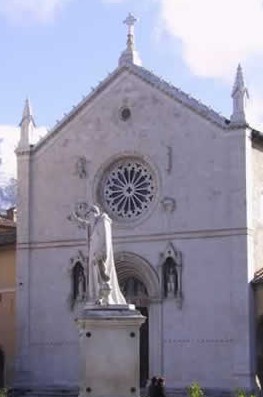
(photo shows the Basilica of St. Benedict in Nurcia, Italy – note the statue of San Benedetto in the foreground)

The Rule of St. Benedict outlines the manner of life in a monastery, including details about how to pray, eat, keep silence, work, welcome guests, admonish wayward members and embodies the Benedictine motto ora et labora which translates “pray and work.”

The job of a monk is to pray. Pray for the world. Pray to God. Pray for all the needs of the Church. Pray for those in need. To take literally St. Paul’s exhortation to “pray without ceasing.” That is the job of the monk.

It is my belief that the world continues to function simply from the prayer of holy monks and nuns. Without their prayers, our world would be drastically different than it is now. The gift of one’s life spent in prayer for the world is the highest gift a person can give. By dying to self (control over their lives) these holy brothers and sisters can then devote their very lives to the service of God, in each and every thing they do throughout the day.

Working in the kitchen of the monastery, cultivating grapes, praying the Divine Office, creating vestments, writing icons or tending to animals. Whatever activities occur during the day, they are done for the sake of the kingdom, everything is done for God.

Thanks to you, holy brothers and sisters of St. Benedict – your very being glorifies God and your humble work edifies the world. Blessed are your hands that do the work of our Lord Jesus Christ in your everyday tasks.

Categories: Catechetics, Saints | Leave a comment

LOBSTERS


Most of my friends know that I enjoy gourmet cooking, and that my wife and I love to travel. In fact, my wife was a travel agent when we were first married, which facilitated lots of wonderful trips that we would not have been able to take otherwise.

What’s the best way to combine these two hobbies of mine? Through lobster, of course! And where do lobsters come from? Well, besides God, I mean. The finest lobster comes from Maine. As such, we have planned (for a long time now) and finally made good on a trip to the land of lobsters, Maine, USA.

One of the driving forces behind the vacation was to search out, find, and consume as much lobster as possible. I’m proud to say that I averaged at least one lobster per day, and on a good day put away two of these exquisitely delicious crustaceans.

Anyway, I thought I’d share with you for the next several entries some highlights from our trip and interesting tidbits learned while on it.

Lobster Fun Facts:

  • Most lobsters are sold as “chicks” – about 1 ¼ lbs in weight – seven years old.
  • American (Maine) Lobsters have claws of different sizes – the larger of the two is the crusher claw and the smaller is the shredder claw.
  • Lobsters can be green, brown, orange, or even blue – they all turn red when cooked, however.
  • Only one-tenth of one percent of lobsters will live beyond their larval period. This is why is it crucial to return to the sea female lobsters carrying eggs, or any that have recently done so (marked by notching a vee into a section of their tail).
  • Although they typically crawl lobsters can sprint backwards very quickly (15 feet per second) by curling and uncurling their tail.

Praise to you, Lord God, King of the Universe – you create all things, including these delightful and fascinating creatures known as lobsters. Thank you, Lord, for these and all your gifts you pour upon us.

Categories: Cuisine, Educational, Travel | Leave a comment

Create a free website or blog at WordPress.com.