Catechetics

Unless you aquire the ears of a child, you cannot understand this homily

Perhaps it’s a God-Incidence, but today’s Gospel account is one that I wrote a children’s homily for some time back.

In Robert Fulghum fashion (author of All I Needed to Know I Learned in Kindergarten), I think the message and content of the homily is timely today, too.

Here’s the Gospel text: (Luke 11:37-41)


After Jesus had spoken,
a Pharisee invited him to dine at his home.
He entered and reclined at table to eat.
The Pharisee was amazed to see
that he did not observe the prescribed washing before the meal.
The Lord said to him, “Oh you Pharisees!
Although you cleanse the outside of the cup and the dish,
inside you are filled with plunder and evil.
You fools!
Did not the maker of the outside also make the inside?
But as to what is within, give alms,
and behold, everything will be clean for you.”


And here’s the homily I spoke about:

Sometimes it’s hard to keep clean. We might be working outside, or playing soccer, and it’s easy to get mud and grass stains on our clothes. It’s not a big deal, though, because our parents help us get those clothes clean again by running them through the washer and dryer. Today we learn about another way of cleaning ourselves from Luke’s gospel.

When Jesus goes to have dinner with the Pharisee, he teaches us an important lesson about being clean inside. The Pharisee is surprised that Jesus does not purify his hands before He sits down to eat. So Jesus takes the opportunity to teach the man that God is more interested in cleanliness of mind and heart than that of his hands.

The reason that the Pharisee was so surprised is because it was a Jewish custom that you had to ritually wash your hands before eating. The man belonged to a group that was obsessed with following all the rules and customs of the Jewish people. He wasn’t trying to trick Jesus; he was just caught off guard when Jesus sat down. He was too focused on the external sign of washing that he missed the whole point of learning what Jesus had to say. And we know that Jesus didn’t simply forget to wash his hands; rather he wanted to teach us a lesson about what makes us clean.

He teaches us today that God wants us to take care of our whole person, because he made every part of us, our bodies and our minds and our hearts, too.

And we all know how we clean our bodies; we take a shower or a bath each day, and we wash our hands before meals. But do we remember to keep our minds and hearts clean, too? Let’s think for a moment about how we can do that –

When we say a prayer for someone we keep our minds clean. When we help our parents with chores is another way. When we stick up for someone is one of the very best ways to keep our minds & hearts clean.

And Jesus today tells the Pharisee another good way to clean our hearts, by giving to the poor. Because when we are taking care of the needs of others we don’t concentrate only on what we want, but what they need, too.

So those are all great ways to help keep us clean, inside and out, just like the cup and dish that Jesus talked about today.

But the very best way to clean our minds and hearts is through the Sacrament of Reconciliation. When we sin, our hearts and minds get cluttered with the things we have done. They distract us from doing what God wants of us. But through this sacrament, Jesus wipes away all of our sins and makes our hearts and minds completely clean. And when we keep ourselves clean, we have more opportunities to help others and to model our lives after Jesus.

So as we continue Mass let’s all think of one way that we can clean our heart by helping someone else this afternoon. That way we can show Jesus that we heard Him speak to each of us personally through the Gospel today.


Categories: Catechetics, Everyday Miracles, Homiletics | Leave a comment

Angels Watching Over Me

Angel is the Greek word for “messenger.” Today is the feast day of Michael, Gabriel and Raphael, archangels.

Much confusion exists about angels today – fueled mainly by a movement within the country toward a so-called “spirituality.” Not the traditional definition of the word, but rather the hijacking of the term by those who profess something along these lines:

  • I think that all religions are more or less the same
  • It doesn’t matter where (or if) you go to church, as long as you live a moral life and believe in Jesus
  • Therefore – I prefer to call myself not religious but rather, spiritual


The short-comings of such thoughts are many – but I think at the core this is driven by a disordered fascination with individualism that is rampant in America today. These old-fashioned denominations are okay for some, but I have some personal, unique insight that just can’t be met by them. I’ll do my own thing – I’ll journey with God in my own way.

And in typical American style, this spirituality movement has been snatched up by clever marketers who make all sorts of angel stuff these days. Books, prints, statues and the like. Lots of the materials available are quite poor theologically (by any denominational viewpoint).

As you go about your day ponder these thoughts about angels:

  • Angels do not have bodies – they are spirits possessing intellect and free will – only in encounters with humans in Scripture do they assume the use of a body
  • Sacred Scripture identifies nine choirs of angels – angels, archangels, virtues, powers, principalities, dominations, thrones, cherubim and seraphim
  • Angels are often depicted as “fairies” assisting people with decisions and such – this is not the nature of an angel
  • Angels are incredibly powerful – MUCH more powerful that humans – an angel could will that the earth smash into the sun and it would happen
  • Angels are not God – they are God’s messengers – sometimes tragic things happen to people, that is the nature of free will in a fallen world, not because your guardian angel wasn’t looking out for you


Categories: Catechetics, Etymology, Ranting, Saints | 1 Comment

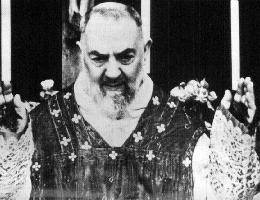
Padre Pio


Today is the memorial of Padre Pio of Pietrelcina (1887 – 1968). Padre Pio was a Capuchin Franciscan who was loved by thousands, perhaps even millions of people. He was canonized by Pope John Paul II in June 2002.

A deeply spiritual friar, Padre Pio offered Masses regularly that went on for three hours or more. He spent incredible amounts of time in private prayer and adoration of the most Blessed Sacrament. Additionally, he spent hours upon end in the confessional counseling, forgiving and assisting people from all over the world.

Our Lord blessed Padre Pio with a collection of supernatural gifts:

  • For instance, he could read the souls of those who confessed to him, and on occasion would point out to them if they were hiding the confession of a sin.
  • He was known to be in two places at one time (bilocation).
  • He was a mystic and had visions and ecstasies.
  • Perhaps more than anything else, he was famous for having the stigmata for over 50 years.

St. Francis also received the stigmata, a gift of inexplicable grace of our Lord Jesus Christ. To bear the wounds that He bore, and to experience, even slightly, the suffering that He did is a mark of incredible holiness, and incredible closeness to our Lord. (remember that the word compassion means “to suffer with”)

You can read more about the stigmata here. It is interesting to note that the majority of saints who have received the stigmata have been women.

Pray for us, Padre Pio – that we may take up our cross each day and follow our Lord Jesus Christ more closely, more willingly and with greater humility.

Categories: Catechetics, Saints | Leave a comment

Matthean Priority?


Today is the feast of St. Matthew, Evangelist.

Numbered among the Twelve, and identified as a tax collector, he answered the call of Jesus. He is also known by the name, Levi.

(This statue of an angel is the symbol of the Evangelist Matthew – it is located on the Duomo (Cathedral) of Orvieto in Italy, which I visited this Spring)


One thing that seems vogue today in Catholic biblical circles is an ongoing discussion of the dating and priority of the Gospels, specifically whether Matthew or Mark was written first.

Logical arguments abound on both sides, but the vehemence with which they are pursued are often over the top for my tastes.

Today it seems harder than ever to agree to disagree on a given topic. Whatever happened to the adage that “men of good will can disagree on an issue?”

Today we have a new adage, you see, many people think that those who don’t believe exactly as they do are somehow suspect, are somehow deficient.

Not only is that factually incorrect, it is also the application of poor logic. We’ve seen much of this faulty thinking around the confirmation hearing of John Roberts to be Chief Justice of the United States. Instead of deciding to confirm him on his legal skill and background, some senators are trying to ascertain how he will decide cases linked to their favorite pet causes.

To disagree with Roberts personal view on abortion, is not a LOGICAL reason to vote against confirming him. A valid, logical reason would be something to do with his abilities as a lawyer or judge.

Perhaps the inspiration that guided St. Matthew in recording the Good News will also inspire the US Senate to judge Roberts on his merits and qualifications, rather than conjecture about a future ruling on a given topic.

Categories: Catechetics, Commentary, Gospel Accounts | Leave a comment

Our father among the Saints . . .

John Chrysostom, Archbishop of Constantinople . . .

Today is the feast day of John Chrysostom, Doctor of the Church. The name ‚Chrysostom translates from Greek as ‚“golden mouth‚” or ‚“golden throat,‚” a reference to his incredible preaching.

(this mosaic is from Hagia Sophia, tenth century)

Mistranslation has occasionally suggested that some of St. John‚’s writings were anti-Semitic; but this is not true. His Orations Against the Judaizers, is sometimes sloppily translated as Orations Against the Jews. Of course a reading of this work in context yields what in fact is a polemic against those in fourth-century Antioch who were trying to Judaize the Christian community.

Many consider John to be the finest Christian preacher. On many occasions his homilies would go on for hours, captivating the people and astonishing them with his oratorical skill.

He revised the Divine Liturgy that is used in Eastern Churches (both Orthodox & Catholic) even to this day.

All who preach ought to be inspired and moved by the abilities of this great saint. His teaching is clear, his exhortations thrilling, and his exegesis rock-solid.

Pray for us, O Golden-Mouthed One, that we might be inspired with your zeal for the Gospel!

Categories: Catechetics, Etymology, Saints | Leave a comment

Pope St. Gregory the Great

Today is the feast day of St. Gregory the Great, Pope & Doctor of the Church.

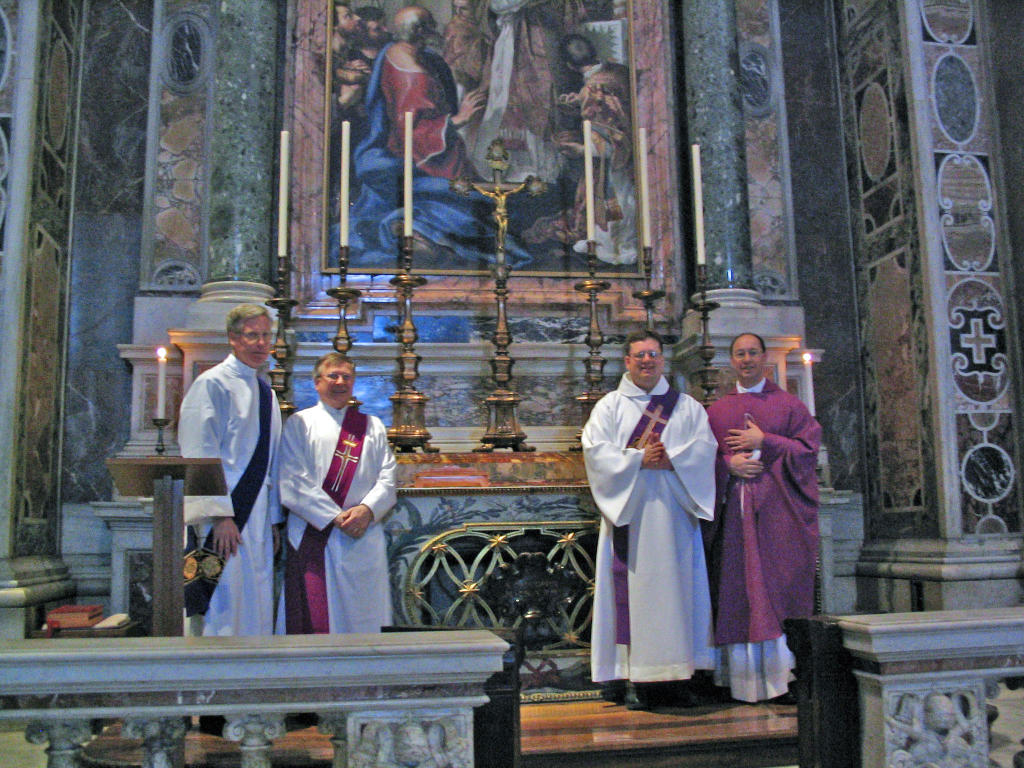
During a trip to Italy this Spring, two of my deacon brothers and I joined Monsignor Tom Fucinaro at St. Peter’s for Mass. (from left Deacon Doug Marsh, Deacon Tom Valasek, myself and Msgr. Fucinaro)

His body is entombed underneath the altar, behind the gold grate.

It was a special privledge for us to do so. St. Gregory is one many popes that was a deacon when he was elected, rather than a bishop or even a priest.

You might find it interesting that from 432 – 684 thirty-seven men were elected pope. Of those the breakdown was:

  • Only three of them were priest or bishops at the time of election
  • Thirty-four were deacons when they were elected

Like Gregory, a deacon elected pope is immediately ordained a priest, and then immediately ordained a bishop. It can even be during the same liturgy that both ordinations occur.

For Gregory it took only about three hours for him to be elected pope, be ordained twice, and then assume the office of the papacy.

Today it is at least theoretically possible for a deacon to be elected pope, but it hasn’t happened for a very, very long time. In fact, even a layman can be elected pope. If he was, he would be ordained a deacon, priest & bishop, all in succession and probably during the same Mass.

It’s not terribly likely though – usually the cardinal electors choose someone that is actually in the Sistine Chapel during the balloting (though they do not have to).

Pray for us, Pope St. Gregory the Great!

Categories: Catechetics, Papal, Saints | Leave a comment

Truth is Sent

For those fortunate enough to get to daily Mass today – there is a wonderful gem waiting in the Liturgy of the Word.

In the First Reading, Paul tells the Colossians about “the word of truth, the Gospel, that has come to you.” (cf. Col 1:1-8)

In the Gospel, Jesus teaches us that, “To the other towns also I must proclaim the good news of the Kingdom of God, because for this purpose I have been sent.” (cf. Lk 4:38-44)

Truth is sent – not passively sought after.

Paul equates the word of truth to the Gospel, Jesus tells the crowds that He has been sent to all the towns of Judea, not just theirs. Jesus is the truth (cf. Jn 14:6), and He is sent to all the nations. Even after He ascended to the Father, the truth continued to be sent – by the apostles and disciples, as witnessed in Paul’s epistle to the Colossians.

And the truth is sent even today. Through the marvels of technology we are sent the truth over radio waves, television signals and print media.

Receive the truth that is sent to you, not the lies of so many purveyors of violence, hatred and filth. The Internet is a perfect example of this – blogs such as this speak about the truth, while thousands of other web sites peddle pornography, get-rich-quick schemes and the like. Like a lighthouse in the dark, be a beacon of truth to a world starving for it.

Jesus, Paul, & Timothy were sent to deliver the truth – and so you must also be an emissary of truth!

Categories: Catechetics, Homiletics | Leave a comment

Create a free website or blog at WordPress.com.